

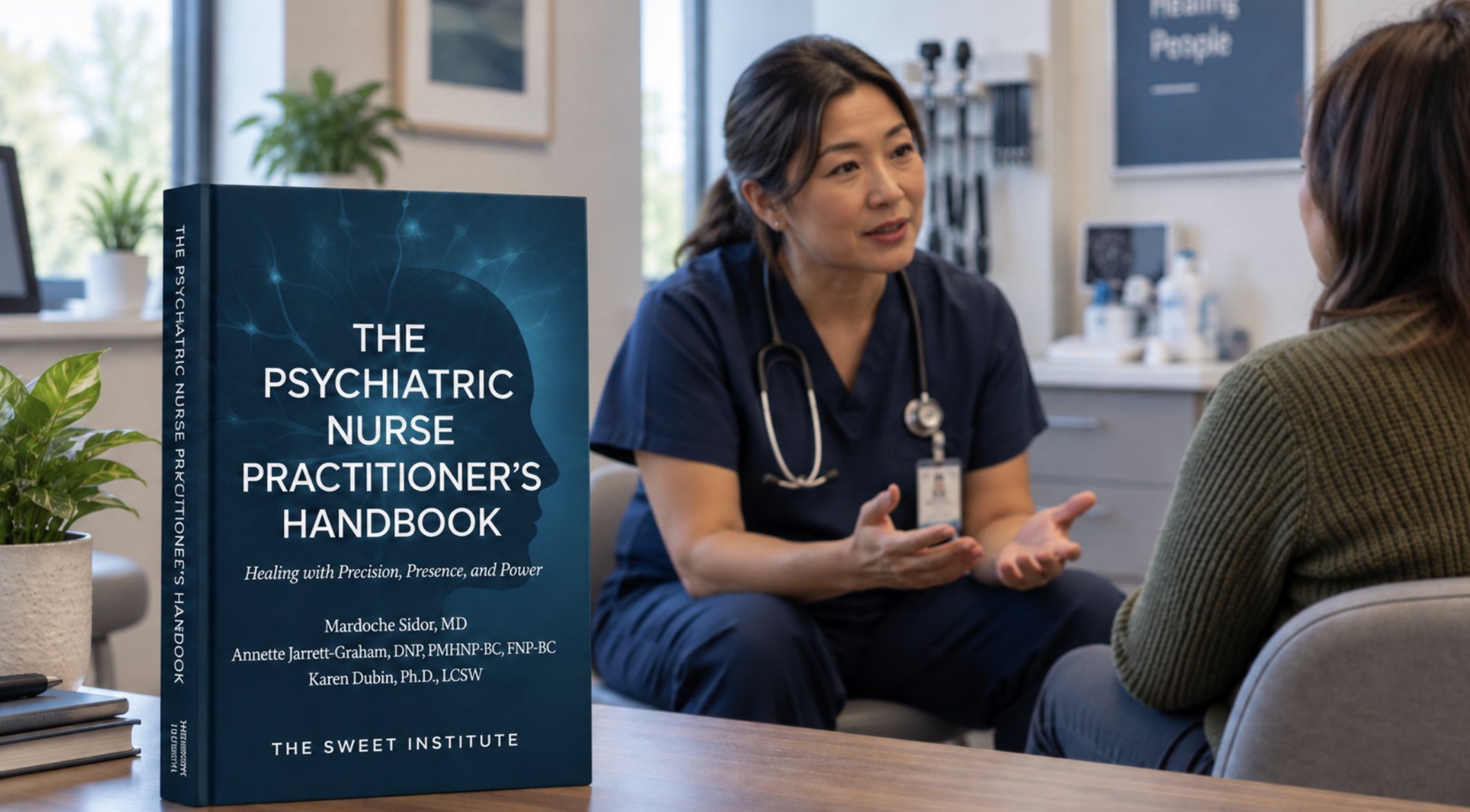
FEATURED BOOK OF THE WEEK: The Psychiatric Nurse Practitioner’s Handbook
More Than Knowing What to Do
Psychiatric practice asks clinicians to know a great deal: diagnosis, psychopharmacology, assessment, and risk. Clinicians also need to know: neuroscience, psychotherapy, medical comorbidity, documentation, ethics, and systems of care.
However, knowledge alone does not make someone an extraordinary clinician.
Two clinicians can know the same diagnostic criteria, understand the same medication, and follow the same evidence-based guidelines, and still create profoundly different experiences for the person sitting across from them.
Why?
Because psychiatric care is not delivered by knowledge alone. It is delivered through a person.
The way we listen matters; the questions we ask matter; what we notice matters; and what we assume also matters. The meaning we make of behavior matters; so does our ability to remain curious when something does not make sense matters; and our capacity to combine scientific precision with genuine human presence may determine whether a patient merely receives treatment or becomes meaningfully engaged in healing.
That is where The Psychiatric Nurse Practitioner’s Handbook begins.
What This Book Reveals
The Psychiatric Nurse Practitioner’s Handbook: Healing with Precision, Presence, and Power explores psychiatric practice as both a science and a deeply human encounter.
It recognizes the importance of diagnostic accuracy, evidence-based treatment, medication management, risk assessment, and sound clinical reasoning. It also refuses to stop there.
The book asks the clinician to look more deeply.
What happened before the behavior we are seeing? What might a symptom be communicating? What strengths already exist that treatment can build upon? What does the patient understand about what is happening? What are we missing because we have become too certain too quickly? And how might the quality of the relationship itself influence what becomes possible?
The handbook invites Psychiatric Nurse Practitioners to integrate knowledge with curiosity, formulation with compassion, treatment planning with collaboration, and clinical authority with humility.
Excellent psychiatric care is not simply about having the right answer. It is about understanding the person well enough to know which answer matters, when it matters, and how to offer it in a way that can actually be received.
The Core Insight
The best psychiatric clinicians do not choose between precision and presence. They bring both.
Precision without presence can become technically correct but emotionally disconnected. Presence without precision can feel compassionate while failing to provide the rigor that complex psychiatric illness demands.
Excellent care requires integration. We assess carefully, formulate thoughtfully, use evidence, and remain curious. We also listen for what has not yet been said; we recognize patterns without reducing people to patterns; and we treat symptoms while continuing to see the human being experiencing them.
That is the work. And that is the power of psychiatric practice at its best.
A Line That Holds the Whole Book
“Clinical excellence is not simply knowing more. It is knowing deeply, seeing fully, and remaining present enough to understand the person behind the symptoms.”
SWEET CALL TO ACTION
This week, choose one clinical encounter and resist the temptation to move immediately toward the answer.
Ask one more question. Listen a little longer. Look for the strength you might otherwise overlook. Question one assumption.
Become curious about something that initially does not make sense. And before asking only, “What should I do?” ask one additional question:
“What do I still need to understand?”
The most powerful clinician in the room is not always the person who arrives at certainty fastest.
Sometimes, it is the person who remains curious long enough to discover what everyone else missed.
And that is where precision, presence, and power meet.
— SWEET Institute Publishing
Transformational Books for a Transformational World